
Mitchell Parole Versus Probation
Parole is conditional release from a TDCJ prison sentence before the sentence has fully expired. The Texas Board of Pardons and Paroles makes the release decision, and the TDCJ Parole Division manages supervision. Mandatory supervision is also a state prison release path, but it follows its own eligibility and review rules. Probation, formally called community supervision in Texas, begins with a court judgment. Mitchell County probation is administered through the 32nd Judicial District Community Supervision and Corrections Department, or CSCD. It is not a branch of TDCJ parole.
The difference controls where to ask. A Mitchell County Jail departure on bond can mean a person is released with a pending case and no probation judgment. A jail departure after a probation order points to the court file and CSCD. A departure from the Daniel Webster Wallace Unit or another TDCJ prison can lead to parole, mandatory supervision, transfer, or discharge. The release record must be read with the sentence record.
| Question | Parole or mandatory supervision | Probation |
|---|---|---|
| Who starts it? | BPP decision under a TDCJ sentence | Trial court judgment |
| Who supervises? | TDCJ Parole Division | 32nd Judicial District CSCD |
| Best status source | TDCJ/BPP result and Parole Division confirmation | Court judgment and authorized CSCD contact |
| Does release end the sentence? | Usually no | Not applicable as a prison-release decision |
- Parole
- Conditional community release while a prison sentence remains active.
- Probation
- Court-ordered community supervision, often used instead of incarceration.
- Discharge
- Authoritative completion of the sentence or supervision term, not merely physical release.
- Absconder
- A person alleged to have stopped reporting or left supervision without permission; the label must come from an official record.
Check Mitchell Supervision Status
There is no researched public name-search that lists every Mitchell County parolee or probationer. TDCJ's online inmate search is built for people currently incarcerated in TDCJ, not a durable directory of people who have left prison. The 32nd CSCD online reporting system is likewise not a public lookup. It requires officer enrollment and is meant for an identified participant to report. A careful check therefore starts with the record that created supervision and uses the named office only after identity is matched.
- Identify whether the last custodian was Mitchell County Jail, TDCJ, or another agency. Do not infer parole from a missing jail entry.
- Match the person with a strong identifier. Use a TDCJ or SID number for a state case, or combine full name and date of birth with the conviction county.
- For parole, check the BPP result through the current TDCJ detail while available or call the BPP status line at 844-512-0461.
- After a favorable vote, call TDCJ Parole Division at (512) 406-5202. A vote code or projected date is not proof that release processing finished.
- For probation, obtain the Mitchell County court judgment and contact the 32nd CSCD through its authorized channel. An office may limit information about an individual.
- Record the agency, time checked, identifier used, and exact wording. Qualify the finding to that agency and date.
A sex-offender registry entry proves registration status, not parole or probation. County VINE, if Mitchell appears in the live selector, concerns a county custody event. TDCJ IVSS handles eligible state notification events. Neither should be turned into a claim broader than the exact event shown.
Mitchell Supervision Office Routes
Mitchell County's two supervision routes point in different directions. The 32nd Judicial District CSCD has a Colorado City office for community supervision. TDCJ's official county-to-district-parole-office map routes Mitchell County parole matters to the Abilene District Parole Office. That map is a contact-routing tool. It does not prove that a named person is assigned there, since an approved residence or later transfer may affect the actual office.
355 Oak Street
Colorado City, TX 79512
(325) 728-3457
Monday-Friday, 8:00 a.m.-noon and 1:00-5:00 p.m.
5241 West Stamford Street
Abilene, TX 79603
(325) 672-1495
Verify the named person's assignment before relying on this route.
Call with a clear purpose and enough identity information. A full legal name alone can collide with another record. A cause number links a probation inquiry to the court judgment; a TDCJ or SID number is stronger for parole. Office staff may confirm routing while withholding details protected by law or supervision policy.
Why Mitchell Offices Differ
The tri-county CSCD in Colorado City and the TDCJ parole office in Abilene reflect two distinct legal systems. CSCD carries out a local court's community-supervision judgment. The TDCJ office carries out state parole or mandatory-supervision conditions after prison release. Even the online tools serve different users: CSCD reporting requires enrollment by an officer, while TDCJ's public current-inmate tools help locate a state prisoner and review a pending decision.
This split matters when someone says “probation office” loosely. Sending a parole question to CSCD can delay a status check. Sending a probation question to TDCJ can produce no useful record. Start with the judgment, BPP material, or release record. Then use the office tied to that source. The CSCD's published noon-to-one closure is also practical: a midday unanswered call does not show that an office or case is inactive.
The local office image in the research manifest comes from the 32nd CSCD contact source.
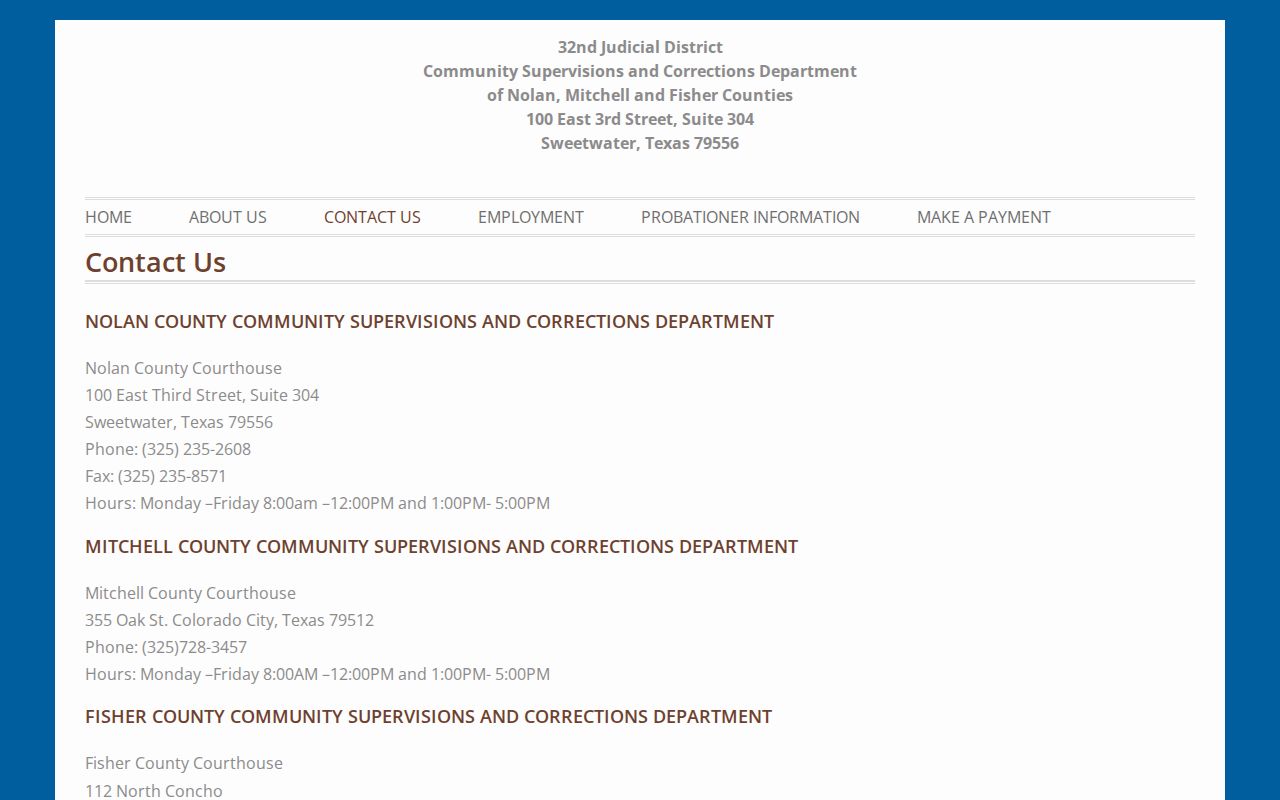
Use the source to confirm office details, not as proof of a person's current probation status.
Mitchell Parole Review Results
Texas does not conduct formal parole or mandatory-release hearings for these cases. There is no public case-by-case hearing-room calendar to search. Parole Division identifies a case before eligibility, an Institutional Parole Officer interviews the inmate and prepares a case summary, and a three-member BPP panel reviews the file. Two matching votes establish the result. General board meetings are not a substitute for this inmate review process.
The official parole review description says initial cases are identified about six months before eligibility and later reviews about four months before review. Results may include an approval tied to eligibility, a future date, or a program and transfer condition. Denials can set another review or require service of the sentence. Use the official result route and vote dictionary because the abbreviations are stages, not plain-language proof of release.
A favorable result remains anticipatory. Classification and Records may still need a release certificate, audit, approved plan, program completion, and detainer review. Call Parole Division after the vote. If the current-only inmate search later drops the name, request an actual release record rather than labeling the person discharged.
Mitchell Violations and Warrants
Conditions vary by the judgment or release certificate. Common categories can include reporting, residence approval, travel limits, programs, or payment terms, but no condition should be attributed to a named person without that person's authoritative document. An alleged violation may trigger review, a warrant, county detention, or revocation proceedings. It does not by itself prove a new conviction.
A parolee temporarily held in Mitchell County Jail can appear in two notification layers. County VINE may report the jail custody event if Mitchell currently participates. TDCJ IVSS may carry eligible parole, warrant, and supervision events. Register in the system tied to the needed event, and see the VINELink Check for the county-versus-state distinction. No result from one system proves the person is free of all other custody or warrants.
Confirm Mitchell Supervision Discharge
Physical release, supervision completion, and sentence discharge are different events. A person may leave prison on parole while the sentence continues. Probation may end through successful completion, court action, revocation, or another judgment-specific event. Only the responsible agency or court record can establish which occurred.
For a TDCJ term, seek the actual release date, release type, and discharge or maximum-expiration date from TDCJ records. The public inmate search is current-only, so a former inmate may disappear. A formal TDCJ public-information request can identify the person by full name, TDCJ or SID number, date of birth, conviction county and cause number, and incarceration range. For probation, obtain the signed Mitchell County judgment or later order from the clerk that holds the case and confirm permitted status details through CSCD.
The Mitchell County release record search helps separate a jail release from a transfer, while the Projected Release Date explains why an anticipated TDCJ date is not completion proof. Preserve the final agency record. A map, registry entry, old vote result, or roster absence cannot replace it.
Texas public-record law does not turn every supervision detail into an open public field. Request the existing judgment, release record, or discharge record from its custodian, who must apply the Texas Public Information Act and any confidentiality law. Sealed, expunged, juvenile, and nondisclosed material needs special care. If an authoritative source restricts or removes a record, do not treat the absence as proof of innocence, non-arrest, or a particular supervision outcome.